
Āz̲arbāyjān, Rūznāmah-i (Firqah-i Dimūkrāt, Pahlavi II)
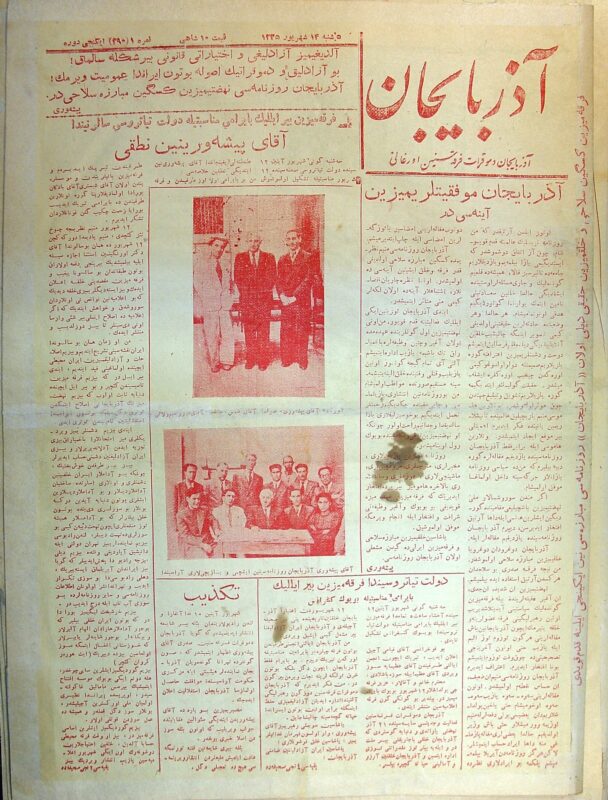
Āz̲arbāyjān, Rūznāmah-i (Firqah-i Dimūkrāt, Pahlavi II)
روزنامه آذربایجان (فرقه دموکرات، پهلوی دوم)
| Digital Collection Type | Newspaper |
|---|
| Publication Place | Asia > Iran > Tabrīz |
|---|
| Era | Pahlavi II |
|---|
| Language | Turkey |
|---|
| First Year | 1324 H.Sh. |
|---|
| Last Year | 1325 H.Sh. |
|---|
| Permalink | https://www.opars.com/collection/az%cc%b2arbayjan-ruznamah-i-firqah-i-dimukrat-pahlavi-ii/ |
|---|
Brochure, Sample Issue
The Firqa-yi Dimukrāt-i Āzarbāyjān (in Azerbaijani Turkish: Azərbaycan Demokrat Firqəsi) was the name of a political party that declared its existence on 3 September 1945 in Tabriz, three months after a confidential directive was issued by the Political Bureau of the Central Committee of the Soviet Union in Tabriz. This party was established under the leadership of Jaʿfar Pīshahʾwarī and with the collaboration of several other Azerbaijani political activists, through the publication of a twelve-point manifesto in both Turkish and Persian. Among its key demands were broader local administrative powers, the teaching of Azerbaijani Turkish in schools alongside Persian, as well as land and economic reforms.
The establishment and subsequent dissolution of the autonomous government of Azerbaijan by this party became a significant episode within the Būḥrān-i Īrān (Iran Crisis), which is regarded as one of the precursors to the Cold War. ʿAlī Shabistarī, leader of the Tudeh Party’s Tabriz branch, later stated that Pīshahʾwarī had received orders from the Soviets to establish the Democratic Party. Pīshahʾwarī’s writings reveal that he dissolved the Tudeh Party and adopted the name “Democratic” to attract individuals who were not aligned with communist ideology.
The Firqa-yi Dimukrāt-i Āzarbāyjān was formed following the Allied forces’ entry into Iran in September 1941 and their occupation of northern regions, particularly Azerbaijan, by the Red Army. Most of its military members were drawn from insurgent groups. A significant number of Iranian job-seekers, especially Azerbaijanis, who had migrated to Russia and the Muslim-populated areas of South Caucasus during the late 19th century and early 20th century, were repatriated to Iran around 1937. These migrants, familiar with Russian language and culture, were more inclined to cooperate with Soviet authorities. Consequently, many joined the provincial organisation of the Tudeh Party after its formation. According to reports from a senior Tudeh Party member who visited Tabriz on the eve of the establishment of Firqa-yi Dimukrāt, most members of the Tudeh Party in Tabriz were migrants. The influence of these migrants within the provincial organisation was so substantial that its structure, comprising over sixty thousand members, was merged into Firqa-yi Dimukrāt on 12 September 1945, just one week after its formation.
The founders of this group, such as ʿAlī Shabistarī, Hilāl Nāṣirī Chāwushī, and Raḥīmī, later joined Firqa-yi Dimukrāt. In 1941, a newspaper titled Āzarbāyjān, which disseminated the group’s ideas under ʿAlī Shabistarī’s management, began publication. Apart from publishing articles and poetry in Turkish, it also featured writings on Azerbaijani language, literature, and history while advocating for provincial councils.
The group and its newspaper were banned and disbanded in 1942. Notably, this same newspaper became an outlet for Firqa-yi Dimukrāt’s ideas on 5 September 1945.