Support
The Tactile and the Technical: Why Digital is the Only Key to the AI Revolution
For many of us, particularly in the rich tradition of Persian culture, the physical book holds a sacred status. There is an undeniable romance in the weight of a volume, the texture of the paper, and the scent of ink. For deep, leisurely reading or appreciating the artistry of calligraphy, the printed book is irreplaceable.
However, we must draw a distinct line between reading for pleasure and analysing for research.
While the heart may prefer the printed page, the modern workflow demands the digital file. This is not a matter of preference; it is a technical prerequisite. To harness the immense analytical power of Artificial Intelligence—to truly “converse” with a text—the data must be digital.
Here, we examine why buying the digital edition is the unavoidable entry ticket to next-level research, especially for Persian texts.
1. The Physical Barrier: Ink Cannot Be Computed
Imagine you are holding a printed copy of a dense historical text or a complex contemporary novel. If you want to analyse the thematic evolution of a character or cross-reference a specific historical date, you are limited by your own eyes and memory.
“Artificial Intelligence thrives on data. A physical book is an ‘offline’ archive; a digital book is ‘online’ data.”
You cannot feed a physical book into an AI model (like ChatGPT or Claude).
- The Reality: Artificial Intelligence thrives on data. A physical book is an “offline” archive. A digital book is “online” data.
- The Necessity: To make the AI your research assistant, you must provide it with the raw material in a language it understands: digital text.
2. The Persian Advantage: Unlocking the Depth of Farsi
This synergy between digital books and AI is particularly revolutionary for Persian literature, which is famous for its ambiguity (Eiham) and layered symbolism. Traditional indexing simply cannot capture the nuance of a poet like Hafez or Rumi.
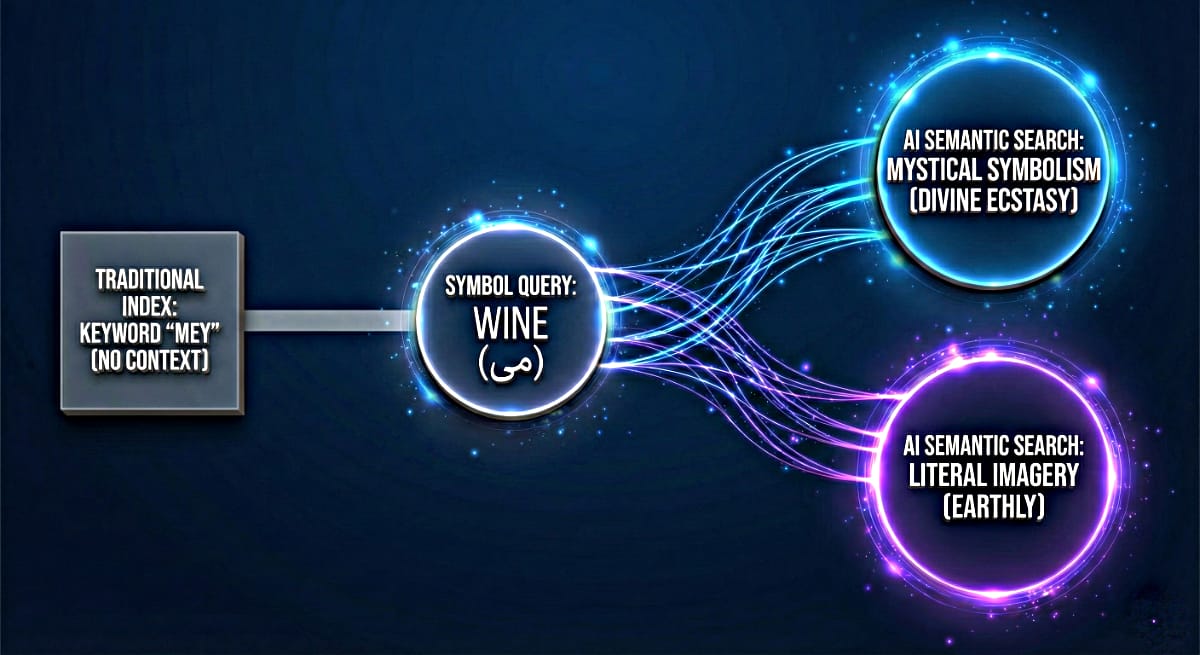
- The Old Way: You are researching the dual symbolism of “Wine” (Mey) in the Divan of Hafez. You wish to distinguish between the literal, earthly drink and the mystical symbol of divine ecstasy. You check the index for “Wine”. The result is hundreds of page numbers with no context. You must manually read every single ghazal to categorise them.
- The Digital + AI Way: You upload the digital file and issue a semantic command:“Analyse every couplet in this collection that mentions ‘Wine’ or ‘The Cup’. Classify them into two distinct categories: those suggesting a literal tavern setting and those representing spiritual intoxication (Sufistic metaphor). Explain the imagery used in each instance to justify the classification.”
Because the text is processable, the AI can look past the keyword and analyse the surrounding metaphors—the “Tavern of Ruin” versus the “Mosque”—to deconstruct the literary device in seconds.
This level of semantic literary criticism is simply impossible with a printed index.
3. The “Hybrid” Researcher
Adopting digital books does not mean you must throw away your library. Many leading intellectuals now adopt a Hybrid Model:
- The Physical Copy: Used for the first read-through, for marking margins with a pencil, and for the joy of holding the work.
- The Digital Copy: Purchased specifically for the “Workbench.” This is the version used to search, dissect, summarise, and interrogate using AI tools.
Conclusion: A Rational Choice for the Modern Mind
We understand that for many, the screen will never replace the sensation of paper. And it doesn’t have to. However, if your goal is to extract knowledge, synthesise information, and produce high-quality research in a fraction of the time, the digital file is mandatory.
“To possess the digital file is to possess the ability to analyse the text at the speed of thought.”
This is why Opars intends to fully support this enhanced method. We recognise that the future of reading is not just about consumption, but interaction. We are actively aligning our platform to ensure that the digital books you acquire from us are optimised not just for reading, but to serve as high-quality, accessible data sources for your AI-assisted research.
To possess the digital file is to possess the ability to analyse the text at the speed of thought—and Opars is here to facilitate that transition.