
Akhtar, Rūznāmah-i (Istānbūl, Qajar)
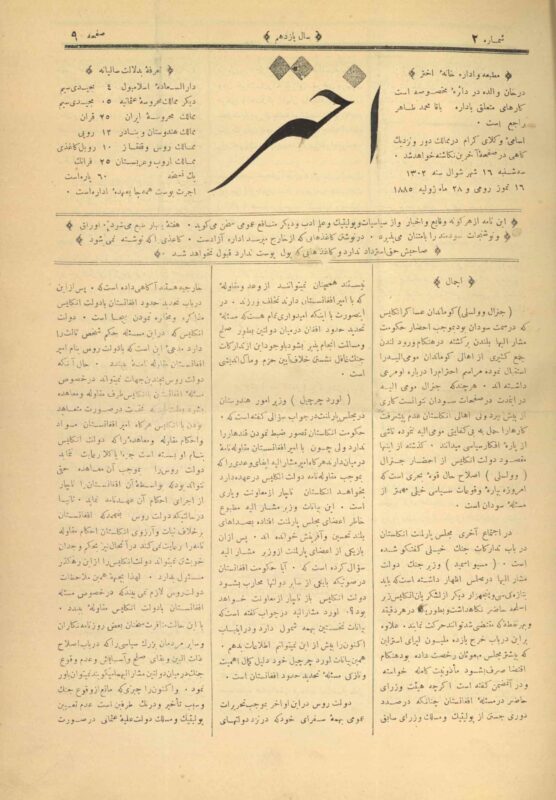
Akhtar, Rūznāmah-i (Istānbūl, Qajar)
روزنامه اختر (استانبول، قاجار)
| Digital Collection Type | Newspaper |
|---|
| Language | Persian |
|---|
| First Year | 1292 H.Q. |
|---|
| Last Year | 1314 H.Q. |
|---|
| Permalink | https://www.opars.com/collection/ruznamah-i-akhtar-istanbul/ |
|---|
Brochure, Sample pages
Sample Issue
Akhtar, a Persian publication that was issued in Istanbul during the late Qajar period, was established with the support of the Iranian ambassador to the Ottoman Empire, Mīrzā Muḥsin Khān Muʿīn al-Mulk (later Mushīr al-Dawla), and with financial assistance from the Iranian government. The journal was managed by Muḥammad Ṭāhir Tabrīzī, while its editorial responsibilities were handled by Mīrzā Najaf ʿAlī Khān Khūʾī, who served as both a translator and deputy at the Iranian embassy. The first issue of Akhtar was published on 16 Dhū al-Ḥijja 1292 Qamari (13 January 1876 CE, corresponding to 23 Dey 1254 Shamsī).
For 22 years, the publication operated consistently until it was banned by the Ottoman government in 1313 Qamari. Initially, Akhtar was published daily, except on Fridays and Sundays. Later, it transitioned to a biweekly schedule, appearing on Saturdays and Wednesdays, and in its final years, it became a weekly publication. Regarding its significance, Edward Browne wrote in volume four of his A Literary History of Persia (p. 314, translated): “Even during my travels in Iran in 1887–88, the only Persian newspaper worth reading was Akhtar, which was printed weekly in Istanbul.” Indeed, during the dark era of despotism, Akhtar played a significant role in enlightening Iranian minds. At a time when Iranian journalism was limited to a few court-affiliated newspapers such as Īrān and Iṭṭilāʿ, Akhtar, as Browne noted, stood out as the only noteworthy Persian-language publication. Particularly valuable were its reports on international telegraphic news, which greatly contributed to familiarising Iranians with global affairs.
There is no doubt that such publications helped prepare public opinion for revolution and that the emergence of constitutionalism in Iran owed much to the sacrifices of those early newspaper managers.
In 1293 Qamari (1915 CE), the publication of Akhtar ceased but resumed in 1294 Qamari with financial support from Tehran. During this period, Akhtar also received backing from the Ottoman government. From 1294 Qamari onwards, the journal’s administration was transformed into a corporate structure, with several Ottoman citizens becoming shareholders.
Akhtar was a progressive publication that played a pivotal role in awakening Iranians both within and outside the country. Articles by prominent writers such as Mīrzā Āqā Khān Kirmānī, Mīrzā Yūsuf Khān Mustashār al-Dawla, Mīrzā Ḥabīb Iṣfahānī, and Fatḥ-Allāh Khān Shībānī were featured in its pages. The newspaper continued its operations until 1313 Qamari (1895 CE, corresponding to 1274 Shamsī).