
Chihrah’namā, Rūznāmah-i (Qāhirah; Qājār, Pahlavi I&II)
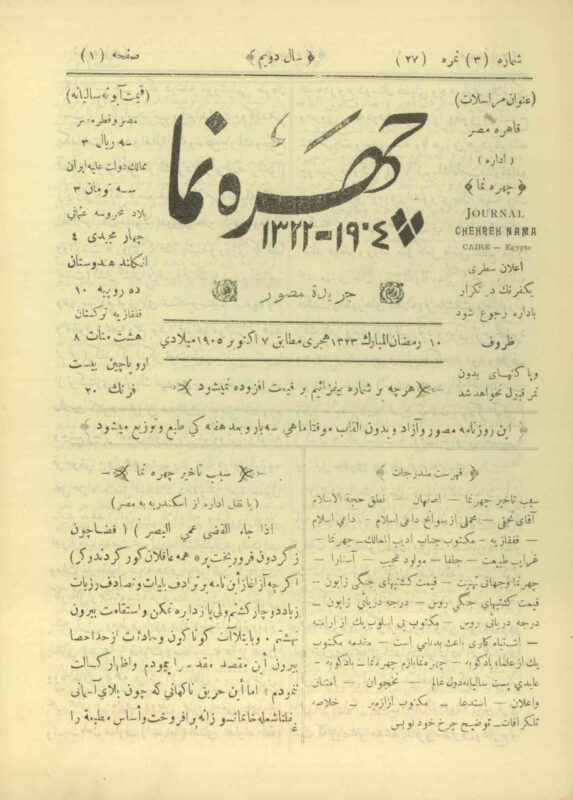
Chihrah’namā, Rūznāmah-i (Qāhirah; Qājār, Pahlavi I&II)
روزنامه چهرهنما (قاهره؛ قاجار، پهلوی اول و دوم)
| Digital Collection Type | Journal |
|---|
| Language | Persian |
|---|
| First Year | 1284 H.Sh.=1323 H.Q.=1905 A.D. |
|---|
| Last Year | 1335 H.Sh.=1375 H.Q.=1956 A.D. |
|---|
| Permalink | https://www.opars.com/collection/ruznamah-i-chihrahnama-qahirah/ |
|---|
Brochure
Sample Issue
Chihrah’namā, a newspaper, was the oldest Persian-language political and social publication and one of the influential periodicals in shaping the thoughts and beliefs of Iranians. Initially published in Alexandria and later in Cairo, it was circulated from the late Qajar period until the mid-reign of the second Pahlavi monarch. The founder and director of Chihrah’namā was ʻAbd al-Muḥammad Īrānī, nicknamed Muʼaddib al-Sulṭān, an Isfahani merchant and writer. He travelled from Isfahan to Baku and then migrated to Egypt, representing the Islamīyah Company, which was established by the initiative and support of the clerics of Isfahan to counteract British economic influence.
In its first issue, Chihrah’namā introduced itself as an “illustrated, free, and untitled newspaper” and was initially published twice a month. This publication, over its 56 years of activity, appeared in four distinct periods. The first period was in Alexandria, which lasted about a year and a half (18 months until the beginning of Jumada al-Thani 1323), before relocating to Cairo due to a fire at the print location.
Chihrah’namā, the illustrated newspaper, was established in Cairo, Egypt, under the management of Ḥājj Mīrzā ʻAbd al-Muḥammad, and following his death, it was managed by his son, Muʼaddabzādah Īrānī. It was first published in 1323 AH, with the initial Cairo issue dated 10 Ramadan 1323 AH (7 October 1905 CE). This issue corresponded to the second year, issue number 3 (serial number 27) of the newspaper. The mentioned issue consisted of 16 pages in square format and was printed in lead type, maintaining its previous style. One of the most significant articles in Chihrah’namā during this period was a critical piece against Amīn al-Sulṭān, following his dismissal from the premiership of Muzaffar al-Dīn Shāh in 1324 AH (year 2, issue 15, pp. 9-10).
Muʼaddab al-Sulṭān, after publishing issue 54 of the third year (10 Shawwal 1324), embarked on a fifteen-month journey to several countries, including Iran. During this period, as he was the sole publisher of Chihrah’namā, the publication ceased. After his return, he resumed the publication (year 5, issue 55, 10 Shawwal 1324), thus beginning its third period, which continued until his death. During this period, coinciding with the minor tyranny era (1327-1326), Chihrah’namā freely expressed truths and praised freedom seekers.
In addition to harsh criticism of tyrants, Chihrah’namā also attacked the foundation of the Qajar government, labelling it “contrary to Islam and against humanity,” and deemed the government’s rule “illegitimate.” Gradually, as the initial fervour for constitutionalism waned, the number of critical articles in Chihrah’namā decreased, and the periodical focused more on reporting significant global events. This trend was particularly evident during the first Pahlavi period, as noted by Moḥīṭ Ṭabāṭabāʼī. It was a moderate publication that consistently wrote in accordance with the times.
The fourth period of the publication began after the death of Muʼaddab al-Sulṭān and under the management of his son, Manūchihr Muʼaddabzādah, continuing until the end of the publication’s life in 1335 SH. During these years, Chihrah’namā included reports on the situation in Iran for the awareness of Iranians residing in Egypt. The news and articles in Chihrah’namā, especially during the first and second periods, mirrored significant events in Iran for a group of intellectuals and political opponents of the Qajar era and beyond.
Overall, Chihrah’namā and similar publications played a crucial role in spreading liberal inclinations in Iran during the Constitutional Revolution, in the absence of a national newspaper within the country and the staleness of state-run newspapers.