
Rūznāmah-i Kāvah (Qājār)
Rūznāmah-i Kāvah (Qājār)
روزنامه کاوه (قاجار)
| Digital Collection Type | Magazine |
|---|
| Periodicity |
|---|
| Manager |
|---|
| Language | Persian |
|---|
| First Year | 1294 H.Sh.=1334 H.Q.=1916 A.D. |
|---|
| Last Year | 1300 H.Sh.=1340 H.Q.=1922 A.D. |
|---|
| Permalink | https://www.opars.com/collection/ruznamah-i-kavah/ |
|---|
Sample Issue
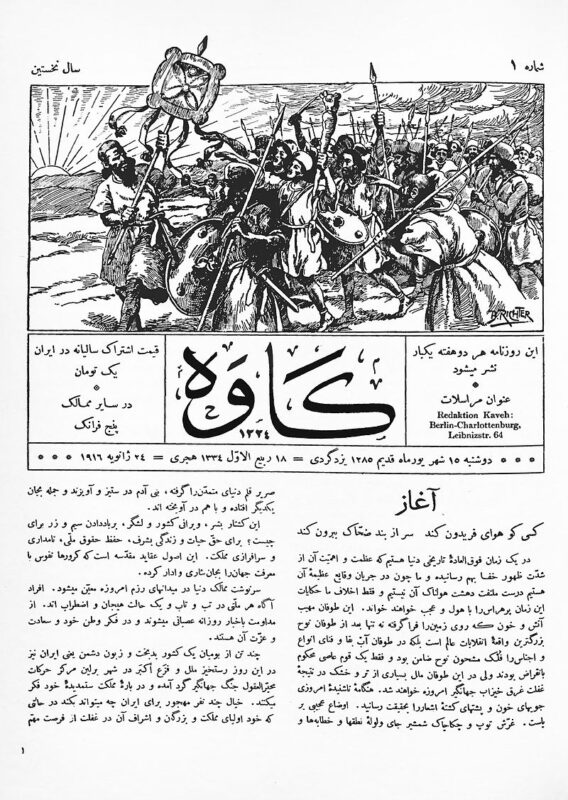
On the third day of Bahman 1294, the first issue of “Rūznāmah-i Kāvah” was published in Berlin, Germany, under the efforts and management of “Ḥasan Taqīʹzādah” and in the Persian language. This magazine was one of the most important sources about antiquarianism in Iran.
During the First World War, Rūznāmah-i Kāvah was published by a political group called “National Defense Committee” to strengthen nationalist, anti-Russian and pro-German sentiments among Iranians under the guise of archaism. One of the reasons why Taqīʹzādah chose “Dirafsh-i Kāvīānī” as the emblem of his publication was that he believed that Dirafsh-i Kāvīānī should be the national emblem of Iranians instead of the lion and sun emblem. Because he claimed that Dirafsh-i Kāvīānī, unlike Lion and Sun, dates back to before Islam.
Kāvah publishing is divided into two periods. The first edition of the magazine started on the 18th of Rabīʻ al-Awwal 1334 (3rd Bahman 1294 A.D. – 24th January 1916 A.D.) and it was published until 15 issues. This period was parallel to the First World War. During this period, Kāvah was a political magazine, and most of its content was in favour of Germany and its allies (Ottoman, Austria and Bulgaria). This serial in its new period from 1338 to 1340 H.Q. published regularly one issue per month.
In its first period of publication, Kāvah was considered the organ of the Democratic Party and had political and propaganda content. The second period of publication of Kāvah in the form of an analytical monthly began in Berlin, and unlike the first period, which had a purely political approach, this time the magazine was published with a critical approach to Iran’s socio-political issues and with an intellectual approach.
Among the authors of this magazine, we can mention such people as Muḥammad Qazvīnī, Muḥammad ʻAlī Jamālzādah (alias Shāhrukh), Ḥusayn Kāẓimʹzādah Īrānshahr, Riz̤ā Tarbīyat, Ismāʻīl Amīrʹkhīzī and Abū al-Ḥasan Ḥakīmī.