
Tawfīq (Pahlavī I&II)
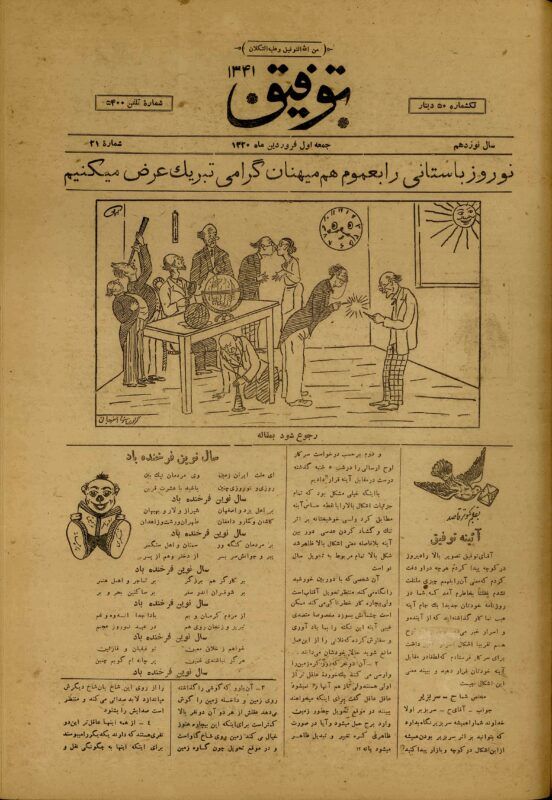
Tawfīq (Pahlavī I&II)
نشریه توفیق (پهلوی اول و دوم)
| Digital Collection Type | Newspaper |
|---|
| Publication Place | Asia > Iran > Tihrān |
|---|
| Era | Pahlavi I; Pahlavi II |
|---|
| Language | Persian |
|---|
| First Year | 1301 H.Sh. |
|---|
| Last Year | 1350 H.Sh. |
|---|
| Permalink | https://www.opars.com/collection/tawfiq/ |
|---|
The first issue of Tawfiq was published in 1302 Shamsi (1923) and its publication continued in three non-consecutive periods. The first period, from 1302 to 1318 Shamsi (1923-1939), was managed by Husayn Tawfiq and ended with his death in 1318 Shamsi (1939). In the early years, Tawfiq was a serious publication with a moral and literary tone, occasionally featuring humorous content. From the middle of the fifth year, after obtaining permission to print cartoons, it became more humorous and eventually turned entirely literary.
During six years of literary activity, Tawfiq’s content was poetic. The first page featured a regular column titled “Shadruwan Fathʿali Khan Ṣaba,” which included his poems, and works by Husayn Tawfiq were also published on this page. Literary competitions were also held. From early 1317 Shamsi (1938), Tawfiq returned to being humorous, focusing on marriage and encouraging young people to marry.
The first period of Tawfiq coincided with the reign of Reza Shah (1304-1320 Shamsi / 1925-1941), leading to the magazine’s content being censored. However, this issue did not exist in later periods. During this time, Tawfiq mainly addressed moral and social issues and was published without interruption.
The second period began after the death of Husayn Tawfiq, under the management of his son, Muhammadʿali Tawfiq, and continued until the coup d’état of 28 Mordad 1332 Shamsi (1953).
Tawfiq’s suspension:
This period, especially after Shahrivar 1320 Shamsi (1941), was marked by a politically open atmosphere and the press’s liberation from oppression. Consequently, Tawfiq’s content, like most other publications, became political and critical, albeit humorously. Political instability, due to the government’s instability, was the main theme for Tawfiq’s increasing criticism of the ruling system, leading to its repeated suspensions. The reasons for suspension were numerous. For instance, documents from 1324 and 1325 Shamsi (1945-1946) indicate that the military governor deemed Tawfiq’s content contrary to national interests and government policy, ordering its suspension.
Tawfiq’s main focus was criticising the performance of prime ministers, often giving them humorous nicknames. Continuous satirical criticism of ʿAbd al-Husayn Hujir, Iran’s prime minister in 1327 Shamsi (1948), led to a two-week suspension (from 9 to 23 Tir 1327 Shamsi / 1948). During this period, the newspaper Dunya-yi Imruz, managed by Husayn Farshid, was published in its place.
Nowruz-i Iran, managed by ʿA. Nowruzi, and Mustahkam, managed by Asadullah Zaki Zada Shabistari, also conveyed Tawfiq’s message by printing “Tawfiq is suspended” on their front pages. During suspensions, Tawfiq’s flag was flown at half-mast at its office and some sales representatives in provincial towns. Tawfiq’s policy in the 1320s Shamsi (1940s) was anti-colonial, continuing in later years. This stance placed Tawfiq among the leftist publications. In 1329 Shamsi (1950), during Razm Ara’s premiership, Tawfiq was listed among the left-leaning publications that the government sought to suppress.
During the peak of the nationalisation of the oil industry, Tawfiq supported the nationalisation of oil and fisheries while continuing to criticise governments.
Tawfiq avoided confrontation with the court, but during the events leading to the coup of 28 Mordad 1332 Shamsi (1953), it sharply criticised the Shah in an article titled “The Black Sedition.”
Muhammadʿali Tawfiq was targeted for this boldness. On 28 Mordad 1332 Shamsi (1953), Tawfiq’s office and his home were looted, and he was exiled to Falak al-Aflak Castle in Khurramabad and Khark Island. He was released after a year on the condition that he refrains from political activity. After the coup, a list of publications allowed to operate was released, but Tawfiq was not included.
Thus, Tawfiq’s publication was halted for four years and seven months until the end of 1336 Shamsi (1958).
The third period of Tawfiq began on 29 Isfand 1336 Shamsi (1958) under the management of Hasan Tawfiq and his brothers, Husayn and ʿAbbas, the grandsons of Husayn Tawfiq’s sister, and continued until 1350 Shamsi (1971). During this period, the magazine’s appearance changed, including a coloured cover and gradually more pages. The editorial of the first issue of the third period indicated a new situation, informing readers that due to restrictions, it could not publish every type of content.
Additionally, the phrases “Tawfiq is a national and independent newspaper not affiliated with any party or group” and “The official organ of the Party of Donkeys” on the back cover reminded readers of Tawfiq’s independence from political groups to avoid past restrictions. The first issue was well-received, with the provincial allocation being distributed in Tehran. The first issue was titled “Humorous Newspaper” instead of its original name, as the weekly Tawfiq was still suspended. Later, with Muhammadʿali Tawfiq’s consent, the publication rights of Tawfiq were transferred to Hasan Tawfiq.