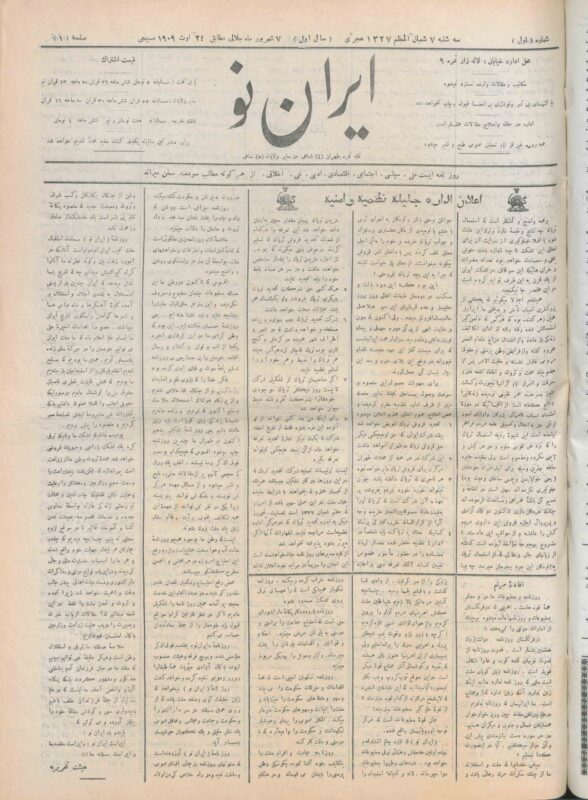
“Īrān-i Naw” was the organ of the Democratic Party and the most important and credible newspaper in Tehran during the Second Constitutional period. Several prominent Social Democrats affiliated with the Democratic Party managed it. One of the significant Persian-language newspapers was Īrān-i Naw, which was published in Tehran for several years before the coup as the organ of the Democratic Party. From the first issue of the second year, in addition to M. Abū al-Z̤iyāʼ, who held the licence, and Sayyid Mahdī Afjahʹzādah, who was the managing director, the name of Muḥammad Amīn Rasūlʹzādah was also included as the editor-in-chief in the newspaper’s masthead.
Rasūlʹzādah was a member of the Baku Social Democratic Party who had come to Iran during the “Minor Tyranny” period.
This newspaper was one of the most influential publications after the Constitutional Revolution. In addition to its critiques of the social system, it was one of the most important newspapers that regularly published articles about the situation of women in Iran, and women themselves wrote in it. Before the establishment and publication of Īrān-i Naw, the size of newspapers was half a sheet, and Īrān-i Naw was the first newspaper to be published in a large format.
The publication of Īrān-i Naw began on 7 Shaʻbān 1327 (2 Murdād 1288 / 24 August 1909) and ceased on 27 Dhū al-Ḥijjah 1329 (29 Āzar 1290 / 20 December 1911) after the closure of the second parliament. In the meantime, one issue was published on 29 Dhū al-Ḥijjah 1329 (30 Āzar 1290 / 21 December 1911) under the name “Īrān-i Nuvīn” and two issues in the following days, 1 and 2 Muḥarram 1330, under the name “Rahbar-i Īrān”.
In 1289, after the exile of one of the newspaper’s agents, Rasūlʹzādah, from Tehran, the newspaper was also suspended, thus ending the first period of Īrān-i Naw. The second period of Īrān-i Naw began after thirteen years of closure, in 1302 AH, and the first issue of this period was published on Tuesday, 25 Thawr 1302, corresponding to 28 Ramaḍān 1341 AH. During this period, “Rahnumā” was introduced as the licence holder and manager of the newspaper, and the newspaper was the organ of the Independent Democratic Party of Iran.
Some of the poems of Malikʹal-Shuʻarāʼ Bahār and Abū al-Qāsim Lāhūtī, progressive poets of the early twentieth century, were published for the first time in this publication. Translations of works by European authors such as Leo Tolstoy and Alexandre Dumas were also made available to the public through publication in this periodical. Additionally, a summary of the book “The Persian Revolution of 1905-1909” by Edward Browne and reports of Browne’s speeches in Europe in support of Iranian constitutionalists were published in this periodical. After the closure of Īrān-i Naw, a few limited issues were published under the titles “Īrān-i Nuvīn” and “Rahbar-i Īrān-i Naw” before it was permanently discontinued. Īrān-i Naw was one of the most serious publications of Iranian socialists in the twentieth century and popularised European-style journalism in Iran.