
Rūznāmah-i Shikūfah (Qājār)
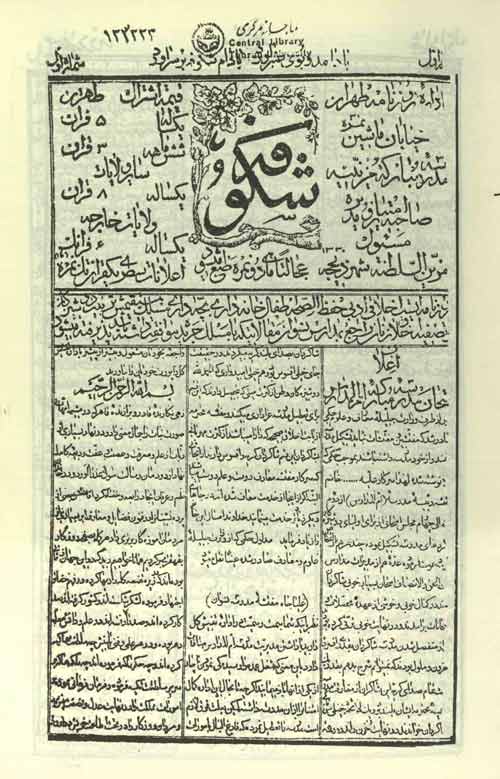
Rūznāmah-i Shikūfah (Qājār)
روزنامه شکوفه (قاجار)
| Digital Collection Type | Newspaper |
|---|
| Editor in Chief |
|---|
| Language | Persian |
|---|
| First Year | 1294 H.Sh.=1330 H.Q. |
|---|
| Last Year | 1298 H.Sh.=1334 H.Q. |
|---|
| Permalink | https://www.opars.com/collection/ruznamah-i-shukufah/ |
|---|
Sample Issue
Shukūfah is one of the oldest women’s newspapers in Iranian history. Its editor-in-chief was Maryam ʻAmīd Simnānī, known by the title Muzayyin al-Salṭanah, and its first issue was published in 1330 AH. Shukūfah is considered the second publication specifically for Iranian women, following the Dānish periodical (1328 AH).
The front page of this publication stated: “The licence holder and managing director is Muzayyin al-Salṭanah, daughter of the late Āqā Mīrzā Sayyid Raz̤ī Raʼīs al-Aṭibbāʼ. It is a newspaper focusing on ethics, literature, child health, housekeeping, childcare, with its primary aim being the education of young women and the refinement of women’s morals, concerning women’s schools. For now, it is published bi-weekly”.
Shukūfah was published as a bi-weekly (four pages) and released 70 issues during its four-year journalistic life. In its first year, 17 issues were published using lithography, and from issue 18 (the first issue of the second year), the printing method changed to letterpress. Shukūfah was the first Iranian publication to print critical caricatures on its back page. The periodical’s distinctive features included its satirical and critical tone, addressing issues facing Iranian women, girls’ education, and political matters.
The publication’s objective was to familiarise women with literary works, dispel superstitions, provide guidance on housekeeping and childcare, and strive to improve women’s morale. Over time, in subsequent years, the magazine’s tone became more strident, and its protests against social conditions became more explicit. For instance, it criticised the tradition of marrying girls at a young age and even objected to the interventions of superpowers, encouraging national independence. One of Muzayyin al-Salṭanah’s most significant actions as the managing director of Shukūfah was introducing candidates approved by women for the third term elections of the National Consultative Assembly, which had consequences.
This publication continued until 1298 in the Solar Hijri calendar, which coincided with ʻAmīd’s death.